
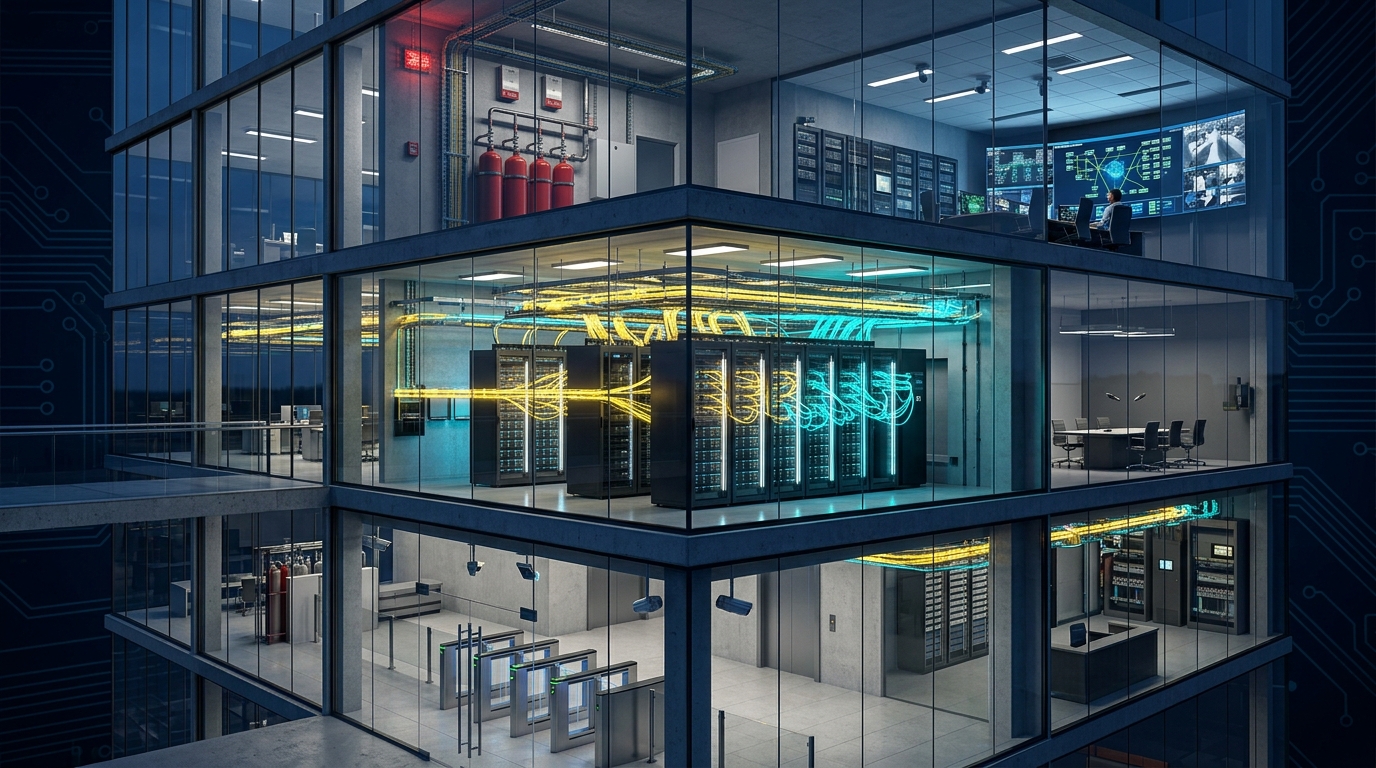
Technology Infrastructure for Connected, Secure Workplaces
Technology-driven facilities depend on resilient connectivity, controlled physical access, integrated life safety and continuously visible infrastructure. HORNET brings these disciplines together into a coordinated operating environment.
Where digital work depends on physical infrastructure.
Inside modern technology campuses and software development centers, intangible code, cloud microservices, and global enterprise operations run entirely on physical foundations: dense Category 6A copper channels, low-loss optical fibre rings, conditioned UPS power, clean-agent suppression, and perimeter access verification.
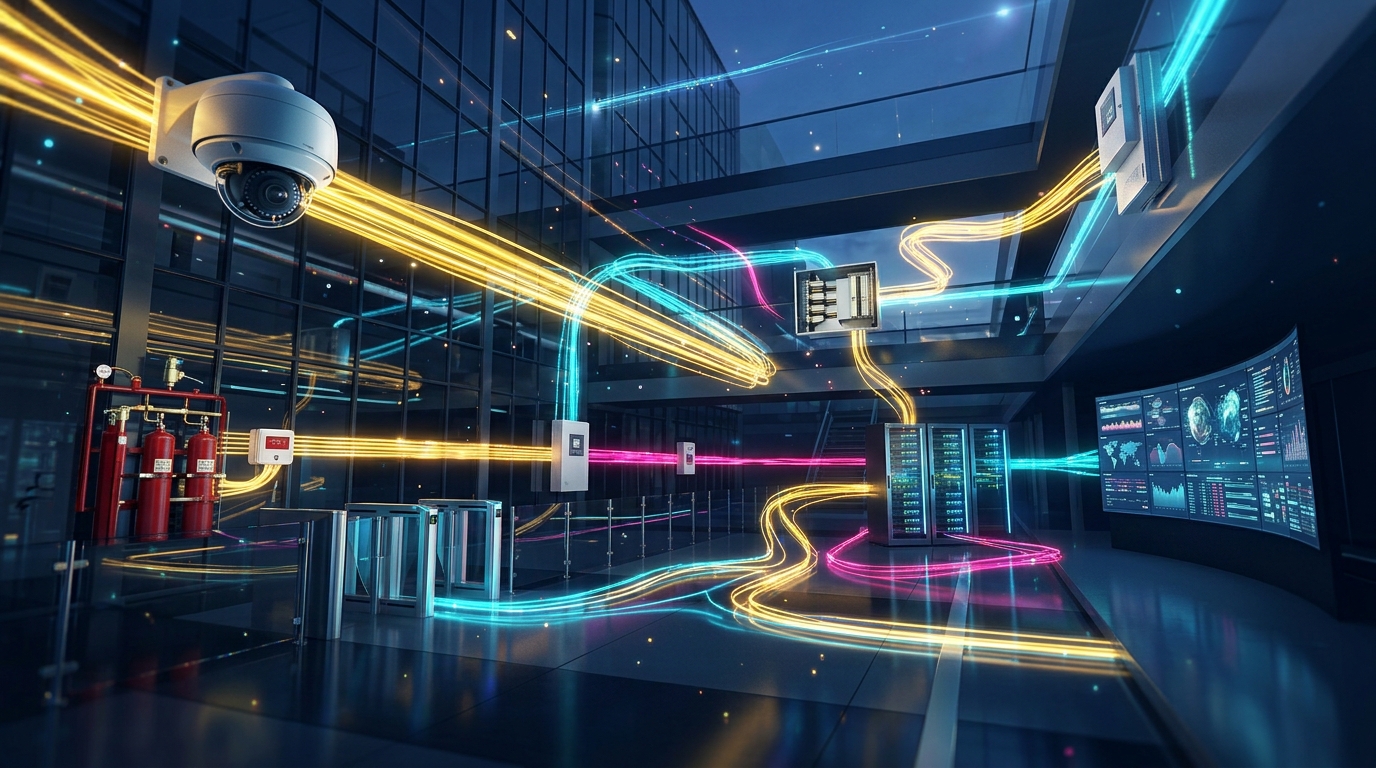
Underfloor consolidation pathways, optical risers, and modular UPS arrays converge into a synchronized facility spine capable of supporting thousands of simultaneous software engineers.
High-Density Occupants & Dynamic Shift Circulation
Tech campuses host immense human densities operating across 24/7 rotating shifts. Speed gates, destination dispatch elevators, and contactless credentials must authenticate employees at sub-second speeds without building bottlenecks at reception portals.
High-Capacity Network Infrastructure & Multi-Gigabit Wi-Fi
Agile scrums, real-time code deployments, and uncompressed 4K video conferences create heavy demands on horizontal links. Structured cabling grids must be shielded against cross-talk and terminated with flawless permanent-link attenuation headroom.
Critical-Room Protection & Power Continuity
Inside server rooms, MDF hubs, and UPS rooms, an undetected electrical spark or fluid leak could halt operations. High-sensitivity laser air sampling (VESDA), clean-agent gas flooding, and real-time battery telemetry protect core infrastructure without downtime.
Facility Profile: Four Pillars of Technology Integration
OPERATIONAL CHARACTERISTICS OF IT/ITES ENVIRONMENTS
DIGITAL WORKFORCE
High occupant density, flexible workplace layouts and controlled movement through shared and restricted areas. High-throughput optical speed gates, contactless credentials, and visitor pass kiosks maintain rapid tenant velocity.
NETWORK DEPENDENCY
Structured cabling, fibre, switching and wireless infrastructure supporting business-critical digital operations. Category 6A LSZH horizontal cabling and redundant single-mode optical backbones eliminate data bottlenecks.
INFORMATION SECURITY
Physical access control, CCTV surveillance and monitored restricted zones supporting facility security. Biometric rack-level locks, mantrap interlocks, and 4K optical verification protect proprietary R&D project labs from unauthorized entry.
CONTINUITY
Life safety, power continuity, critical-room protection and facility monitoring supporting resilient operations. Modular online UPS, clean-agent suppression, aspirating smoke detection, and water leak sensing ensure operational survivability.
Convergence Architecture: 8 Disciplines into 1 Operating Environment
HORNET integrates physical cable pathways, high-speed optical backbones, electronic security, life safety, unified AV, critical-room defense, and facility automation into a single, cohesive operating fabric centered around the connected technology facility.
Physical Infrastructure
LAYER // STRUCTURAL & PATHWAYSICT & Network Backbone
LAYER // GIGABIT DATA HIGHWAYSecurity & Access Control
LAYER // PERIMETER & PHYSICAL IDENTITYLife Safety & Protection
LAYER // STATUTORY LIFE DEFENSECommunications & Collaborative AV
LAYER // WORKPLACE INTERACTIONCritical Room Protection
LAYER // RESILIENT ASSET DEFENSEBuilding Automation & Power Continuity
LAYER // POWER & ENVIRONMENTAL CONTROLFacility Operations & NOC/SOC
LAYER // CENTRAL SUPERVISORY HUBPhysical Infrastructure
Heavy-duty cable trays, basket containment, optical fibre raceways, and fire-stopped riser sleeves.
Forms the physical pathways and structural conduits that safely route high-density optical and copper trunks throughout campus risers and floorplates.
Spatial Deployment Map: 8 Technology Facility Sectors
Explore how electronic low-voltage, high-density optical cabling, addressable life safety, and critical power systems distribute across specific architectural sectors of a technology campus.
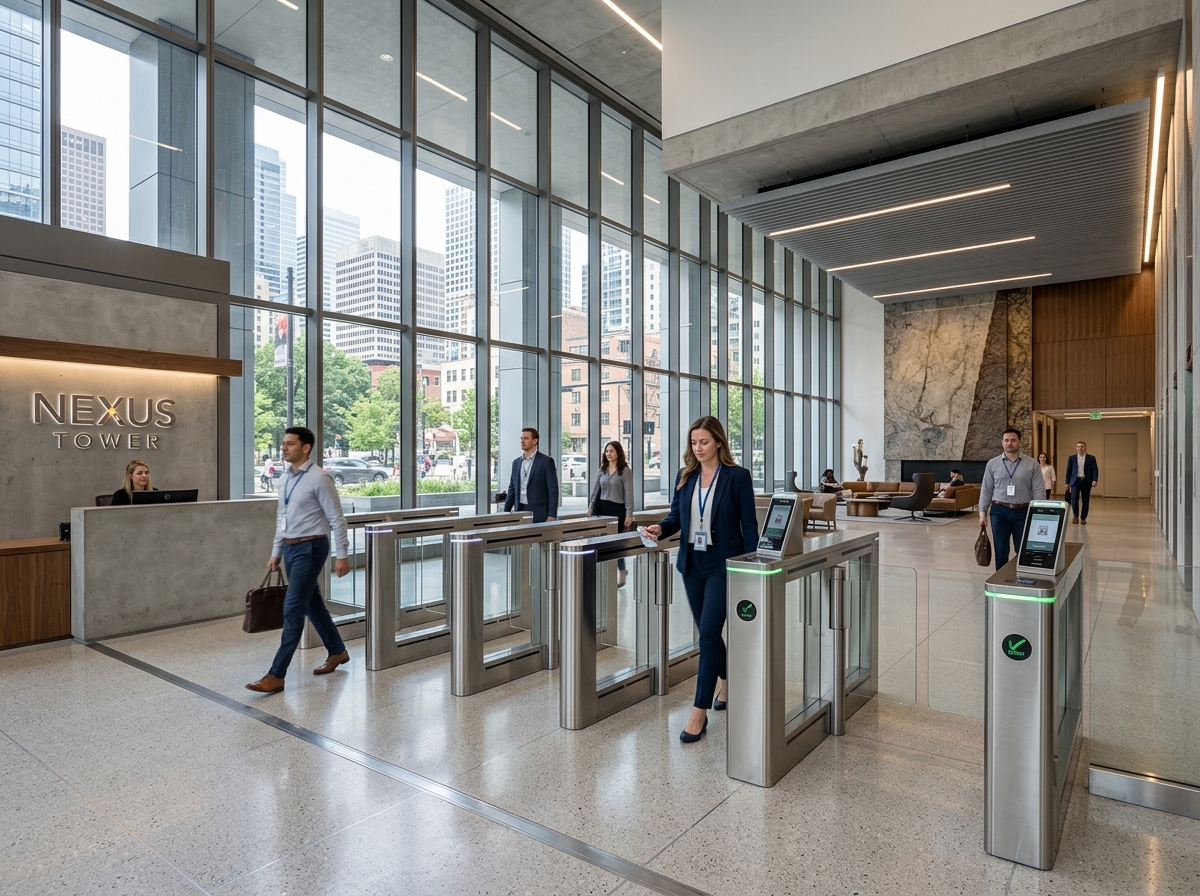
High-speed brushless motorized barriers, dual-frequency RFID long-range tags, 4K IR bullet cameras with perimeter analytics, IP66 rated intercom columns with push-to-talk call station.
Campus Entry & Security Gate
First line of authentication for technology campus employees, authorized engineering contractors, and registered logistics couriers. Enforces automated vehicle identification and anti-tailgating pedestrian verification before physical building approach.
Representative Engineering Scenarios
These scenarios illustrate representative engineering methodologies for IT/ITES facilities. They demonstrate architectural approaches across greenfield campuses, high-density agile workplaces, restricted R&D suites, and operational brownfield retrofits.
Greenfield Technology Campus
A 20-acre master-planned IT/ITES business park featuring 4 interconnected multi-tenant towers, dedicated utility substation, and central shared amenities.
Deploying a resilient campus-wide ICT backbone and unified physical security infrastructure across multiple buildings before tenant fit-out phases, ensuring scalable tenant demarcation without single points of failure.
Engineered a dual-ring subterranean singlemode optical fibre campus backbone through concrete duct banks with diverse physical routes. Centralized campus security command at the main gatehouse while provisioning dedicated, isolated IDF risers for incoming enterprise tenants.
- Dual-ring OS2 single-mode optical fibre backbones terminating in redundant campus core switches
- ANPR boom barriers and optical flap speed gates integrated with centralized campus badge server where specified
- Campus-wide addressable fire alarm network with optical fibre network interface cards (NICs) between buildings
- Open-protocol BACnet BMS monitoring central chillers, cooling towers, and 11kV electrical substations
Cross-Subsystem Signal & Interface Flows
True facility integration is proven when an event in one discipline autonomously orchestrates actions across others. The following sequential flows represent standard cause-and-effect interfaces deployed where specified and as designed.
FORCED DOOR / UNREGISTERED ACCESS ATTEMPT AT SECURE LAB
Field Reader / Sensor Alert
Door contact sensor triggers tamper flag, or reader registers 3 consecutive invalid biometric attempts.
IP Access Controller Logic
Field controller logs unauthorized event code and transmits encrypted alert to Security Management Server.
VMS Camera Matrix Cross-Trigger
Video Management System switches nearest 4K pan-tilt-zoom camera to the portal, buffering 10s pre-alarm footage.
SOC Operator Screen Notification
Main video wall flashes visual alarm icon and expands camera feed to primary operator workstation.
Guard Patrol Tablet Notification
Automated push alert with high-resolution still capture dispatched to closest patrolling campus guard.
Structured Integration Lifecycle: 7-Stage Sequence
Every IT/ITES technology environment delivered by HORNET follows a rigorous, engineering-led lifecycle designed to eliminate MEP clashes, guarantee statutory compliance, and ensure zero unplanned cutover downtime.
Site Assessment & Infrastructure Audit
Comprehensive architectural walk-through, civil pathway verification, optical riser capacity analysis, and baseline EMI electromagnetic audit for technology spaces.
Requirements Engineering & Bandwidth Modeling
Translating occupant headcounts and sprint densities into structured cabling channel counts, Wi-Fi 6 AP density simulations, and power draw metrics.
Converged System Architecture
Engineering high-level network topology, optical fibre diverse ring routing, VLAN segmentation for security/life safety, and cause-and-effect matrix formulation.
Detailed Engineering Design & BIM Coordination
Generating CAD containment layouts, cable tray elevation schedules, electrical single-line diagrams (SLDs), and clash resolution with HVAC ducts and plumbing.
Structured Deployment & Systems Integration
Precision pulling of Cat6A LSZH cabling, optical fusion splicing, equipment rack dressing, field device mounting, and central head-end terminations.
Testing, Verification & Statutory Commissioning
100% permanent-link Fluke DSX certification, OTDR optical insertion loss testing, sound pressure level (SPL) voice alarm verification, and fire cause-and-effect trip tests.
AMC, SLA Performance & Lifecycle Support
Scheduled preventive maintenance, 24/7 incident response SLA where contracted, firmware patching, battery conductance tracking, and spare parts management.
Curated Systems for IT/ITES & Technology Facilities
Explore the individual specialized engineering disciplines that HORNET deploys and integrates into technology campuses, software development hubs, and mission-critical technology facilities.
Related Facility Environments
Plan Your Technology Campus or Workplace Infrastructure
Consult with HORNET engineering specialists to review your greenfield IT park master plans, interior software workplace fit-outs, or live brownfield infrastructure modernization programs.
J-50, Abul Fazal Enclave, Okhla, New Delhi-110025