
Infrastructure for
Trusted Financial Operations
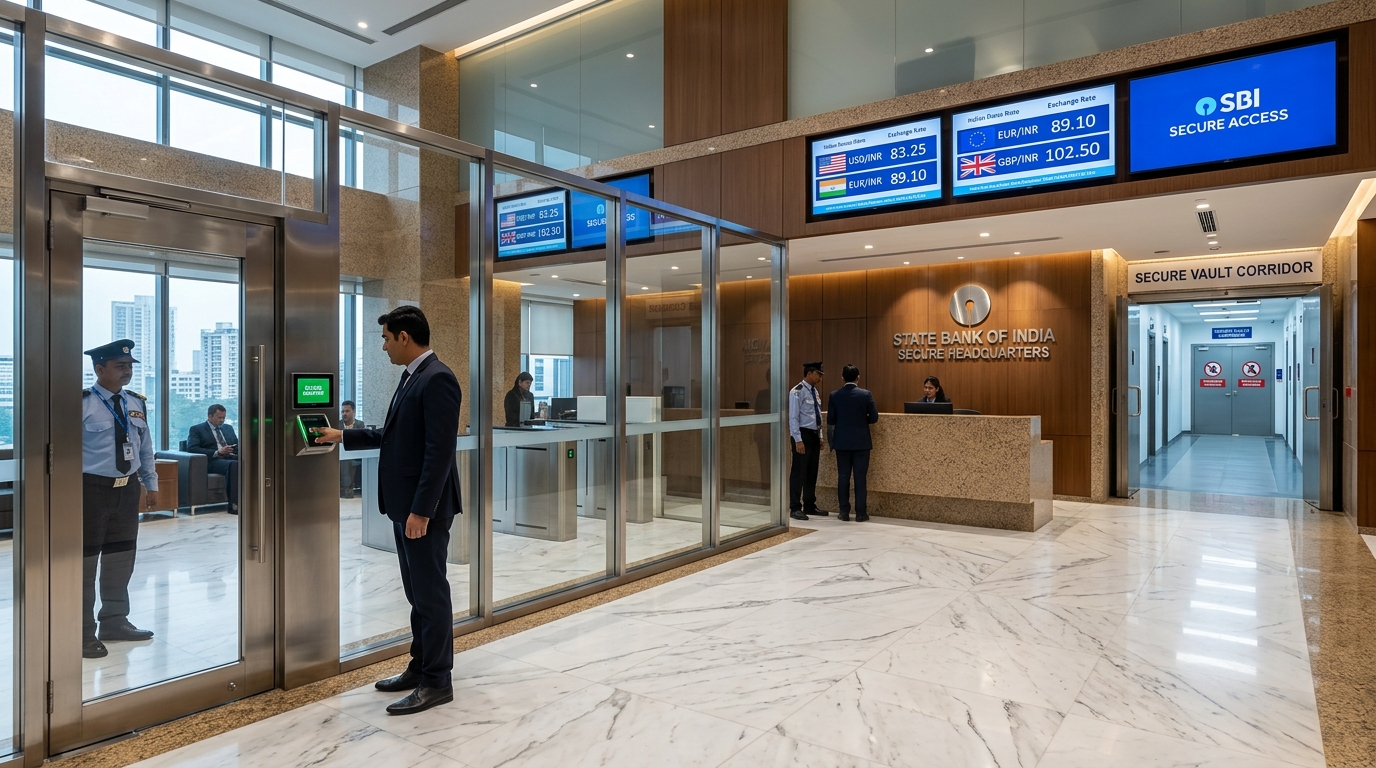
Financial facilities combine controlled customer access, continuous security monitoring, resilient connectivity, life-safety systems and protected operational infrastructure. HORNET integrates these disciplines into a coordinated facility environment.
THE OPERATING ENVIRONMENT:
WHERE TRUST DEPENDS ON CONTROLLED INFRASTRUCTURE
Modern banking facilities are among the most demanding physical environments in the built world. From retail bank branches and regional headquarters to cash operations centres and customer service hubs, every square meter must balance welcoming customer engagement with strict, auditable physical containment.
Customer Movement & Public Thresholds: The customer journey must remain effortless and dignified, guided by clear architectural lines. Yet beneath this open aesthetic lies calibrated perimeter surveillance, anti-tailgating verification, and discrete security checkpoints that maintain absolute spatial boundaries between public lobbies and restricted banking cores.
Employee & Restricted Operations: Behind the teller line, financial operations require rigorous segmentation. Access to cash drawers, customer collateral files, and managerial authorization desks is governed by encrypted credentials, dual-custody verification rules, and automated audit logging to prevent unauthorized cross-boundary movement.
ATM & 24/7 Self-Service Environments: Street-facing vestibules operate autonomously around the clock. These unattended zones demand specialized physical security: structural vibration sensors to detect physical tool tampering, covert pinhole facial cameras, heat rate-of-rise detectors, and automated remote alarms that operate independently of branch open hours.
Secure Records, Vaults & Clean-Agent Protection: Strongrooms and physical loan document archives cannot tolerate standard water sprinkler activation during an incidental thermal flare. They require gaseous clean-agent fire extinguishing systems (such as Novec 1230 or FM-200) coupled with aspirating smoke detection, dual-person rule interlocks, and continuous 24/7 high-framerate optical recording.
Power Continuity & Centralized Telemetry: Financial transactions cannot withstand even a fraction of a second of power disruption. Online double-conversion modular UPS units condition sensitive electrical loads and guarantee zero transfer interruption to core banking terminals and NVR storage during utility blackouts, while broadcasting telemetry to regional monitoring hubs.
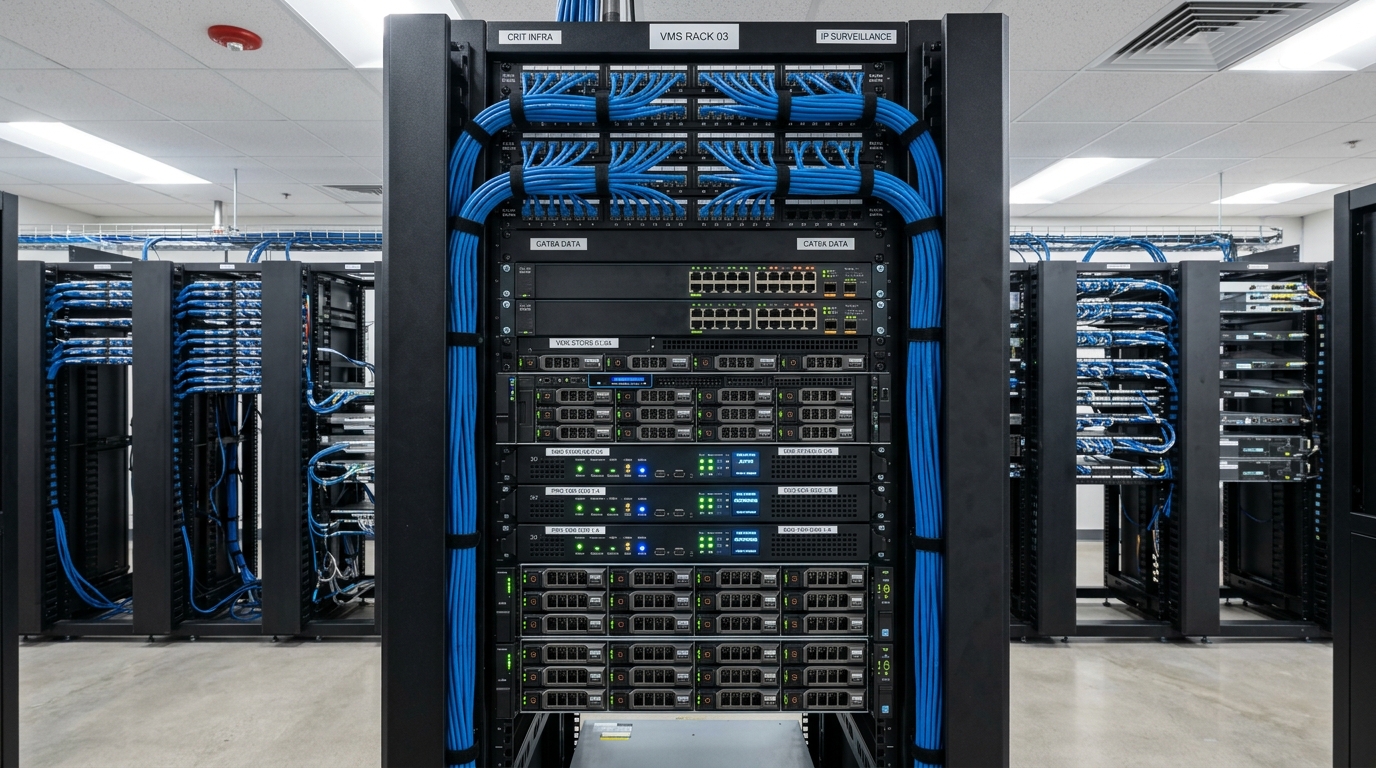
Synchronized optical coverage focused on cash transfer points, customer counters, and strongroom perimeter boundaries.
Architectural Imperatives for Financial Facilities
Every financial institution relies on four fundamental engineering pillars to maintain physical integrity, transaction credibility, and continuous operational resilience.
Trusted Access
Controlled movement for customers, employees, contractors and authorized personnel. Enforces rigorous perimeter demarcation, anti-tailgating verification at corporate turnstiles, and biometric dual-custody authorization for vault rooms and cash management enclaves.
Transaction Security
Continuous visual and event monitoring across customer, transaction and restricted environments. High-resolution teller cameras, 24/7 ATM pinhole surveillance, and tamper-resistant recording arrays eliminate disputes and maintain verifiable audit trails.
Connected Operations
Structured cabling, fibre, networking and communications infrastructure supporting distributed financial operations. High-density Category 6A cabling and redundant optical risers transport core banking traffic, VoIP, and multicast video without packet loss.
Continuity
Life-safety, power continuity, critical-room protection and facility monitoring supporting operational resilience. Synchronized addressable fire alarms, clean-agent extinguishing, aspirating smoke detection, and 0ms online modular UPS conditioning preserve active transactions.
Convergence Architecture:
Controlled Financial Facility
In modern financial environments, physical security, data networks, life safety, and electrical conditioning cannot exist as uncoordinated silos. HORNET integrates these eight core engineering layers into a cohesive, verified facility architecture.
Physical Infrastructure
ICT & Network Backbone
CCTV & Electronic Security
Access Control
Fire & Life Safety
Critical Room Protection
Communications & AV
Facility Operations
Physical Infrastructure
Cable containment trays, standardized server enclosures, clean earthing, and equipment housing.
Forms the physical backbone. Segregates high-voltage power feeds from sensitive Category 6A data cables in compliance with telecommunication pathway standards.
- ›Perforated Cable Trays & Underfloor Wire Baskets
- ›Standardized 42U & 24U Server Enclosures with Lockable Mesh Doors
- ›Dedicated Telecom Earthing Busbars & Clean Earth Pits
- ›Heavy-Duty Floor Boxes & Flush Wall Outlets at Teller Counters
Spatial Deployment Architecture
Financial buildings operate across distinct physical security zones. Select a facility zone below to inspect the spatial role, typical hardware schedules, and integrated ELV/ICT engineering requirements.
Branch Entry & Perimeter
First line of authentication and visual supervision for retail branch customers, corporate couriers, and bank personnel. Integrates exterior ultra-wide dynamic range surveillance to eliminate facade glare, automatic door interlocks, and emergency lock-down mechanisms where specified by security protocol.
Weatherproof vandal-resistant IK10 bullet and dome IP cameras, optical pedestrian turnstiles with integrated smart card readers as designed, break-glass manual release units with monitored door contacts.
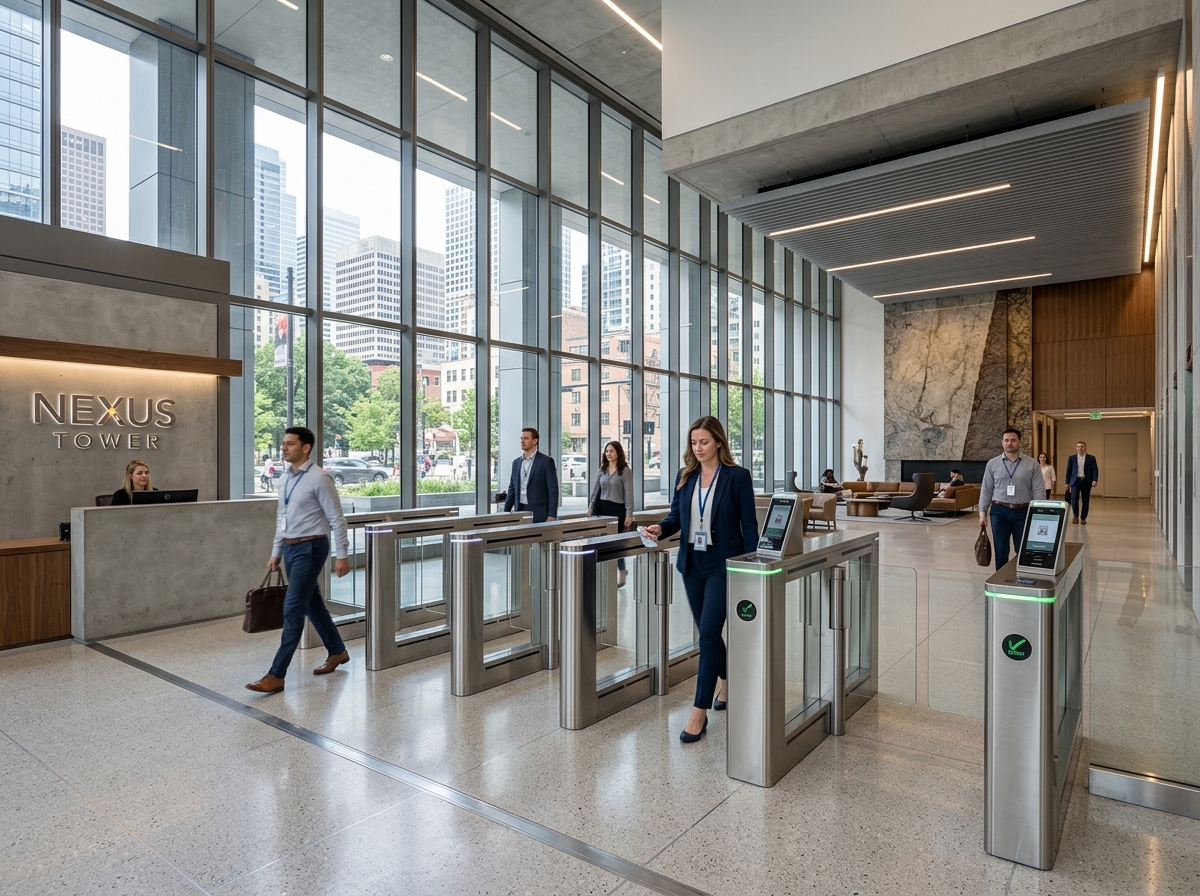
Equipment specifications and cable pathways for Branch Entry & Perimeter must be confirmed during project schematic design to ensure proper coordination with architectural barriers, finishes, and structural openings.
Representative Engineering Scenarios
These scenarios illustrate representative engineering methodologies for financial facilities. They demonstrate architectural approaches across greenfield branches, distributed retail branch rollouts, corporate financial headquarters, and operational brownfield modernizations.
New Banking Facility
FACILITY ENVIRONMENT & CONTEXT
A newly constructed 4,500 sq.ft. commercial retail banking branch in a prime metropolitan commercial district, including a customer concourse, teller counters, 24/7 ATM vestibule, secure cash room, and server closet.
ENGINEERING CHALLENGE
Architectural and interior deadlines required all ELV, security, containment, structured cabling, and fire detection conduits to be fully coordinated before false ceilings and modular acoustic wall paneling were closed.
INTEGRATION STRATEGY
Executed unified BIM/CAD pathway coordination during rough-in stages. Installed heavy-duty perforated cable trays segregating data and power, cast-in-slab floor boxes for teller desks, and pre-wired dual-angle teller camera feeds before furniture installation.
KEY SUBSYSTEM INTEGRATIONS EXECUTED
- Pre-coordinated underfloor containment linking teller counters directly to branch MDF room
- Covert pinhole camera integration inside custom joinery at all customer cash transfer points
- Integrated addressable fire alarm loop linking FACP to magnetic door holders and AHU trip coils
- Clean-agent fire extinguishing cylinders installed within strongroom with dual-detector release interlock
Every deployment scenario represents an engineered approach subject to site-specific architectural parameters, local municipal statutory approvals, and client security standards.
Cross-Subsystem Signal & Interface Flows
When an anomalous event occurs in a banking environment, safety and security depend on deterministic, automated signal handoffs across access, CCTV, fire alarms, and electrical systems.
Security Breach & Optical Audit Verification
Field Reader / Tamper Alert
Door contact sensor registers mechanical forced opening, or reader logs three consecutive invalid credential attempts.
IP Access Controller Logic
Door controller flags unauthorized entry event code, activates local door sounder, and transmits encrypted alert to Security Server.
VMS Camera Matrix Cross-Trigger
Video Management System switches nearest 4K fixed / PTZ camera to the portal, buffering 10s pre-alarm footage.
SOC Operator Screen Notification
Security console flashes high-priority red alert window with live video stream, audible chime, and site map coordinate.
Guard Patrol & Lockdown Response
On-duty branch security or roving armed patrol dispatches immediately; operator initiates electronic interlock lockdown if required.
The HORNET Engineering Approach
From initial branch security audit and pathway coordination through certified Fluke OTDR testing and multi-year AMC lifecycle support, HORNET delivers methodical, end-to-end systems integration.
Site Assessment & Risk Survey
Thorough evaluation of physical branch geometry, public customer flow, cash transaction zones, vault perimeters, existing electrical risers, and structural containment limitations.
Operational Requirements Engineering
Close collaboration with bank security officers, facility heads, and IT teams to define retention requirements (e.g. 90-day CCTV storage), dual-custody access rules, and bandwidth budgets.
System Architecture & Schematic Design
Development of detailed ELV/ICT single-line schematics, IP network topology, VLAN assignments, power consumption schedules, and integrated cause-and-effect matrices.
Design & MEP Coordination
Coordination with interior architects, electrical contractors, and HVAC teams to eliminate clashes in false ceiling voids, cast-in-floor conduits, and security barrier placements.
Structured Deployment & Integration
Precision cable pulling, rack dressing, camera aiming, sensor termination, and clean equipment installation executed under certified method statements and strict site safety rules.
Testing, Verification & Commissioning
End-to-end validation including certified Fluke Category 6A / OTDR optical testing, lux-level camera verification, simulated smoke aerosol trials, and online UPS load-bank testing.
AMC & Lifecycle Support
Preventive maintenance contracts, scheduled optical lens cleaning, battery impedance testing, firmware patching, and rapid-response emergency breakdown support across branch networks.
Curated Engineering Disciplines
Explore the dedicated HORNET engineering disciplines deployed across banks, corporate financial facilities, and branch networks. Each connects to our canonical solution engineering dossier.
Electronic Security & Access
Surveillance, credentialed transit, and perimeter security designed for financial accountability.
Addressable Life Safety
Early fire detection and gas suppression preserving both human life and valuable financial records.
Data Backbone & Power
Ultra-reliable structured cabling, rack infrastructure, and 0ms online UPS power redundancy.
Voice, Video & Telephony
Voice alarm evacuation, boardroom conferencing, executive video walls, and enterprise IP telephony.
Facility Telemetry
Centralized supervisory monitoring for lighting, energy consumption, and environmental control.
Environment Defense
Specialized detection safeguarding server closets, strongrooms, and critical risers.
Full Lifecycle Engineering Capabilities
From initial schematic design and MEP clash coordination through multi-year comprehensive AMC service contracts.
Related Facility Environments
Corporate Offices & Commercial Buildings
Multi-tenant commercial towers, enterprise corporate headquarters, and business parks.
IT/ITES & Technology Facilities
High-density tech campuses, software development hubs, and mission-critical engineering centres.
Data Centres & Mission-Critical Facilities
Tier-rated server halls, colocation centres, and high-availability technical infrastructure.
Government & Public Infrastructure
Municipal secretariats, public utility facilities, and critical administrative complexes.
Healthcare & Medical Facilities
Multi-specialty hospitals, research clinics, and patient-centric healthcare centres.
Manufacturing & Industrial Facilities
Automated factories, logistics warehouses, and heavy production plants.
Engineer Your Financial Facility Infrastructure
Connect with our senior systems engineering team to coordinate physical security, high-integrity structured cabling, clean-agent suppression, and online UPS architecture for your banking or financial facility.