
PA & Voice Alarm
Engineered public address and voice alarm systems for clear communication, paging, background audio and emergency voice messaging across commercial, institutional, industrial and critical facilities. We deliver verified acoustic coverage, prioritized life-safety evacuation routing, and reliable system supervision.
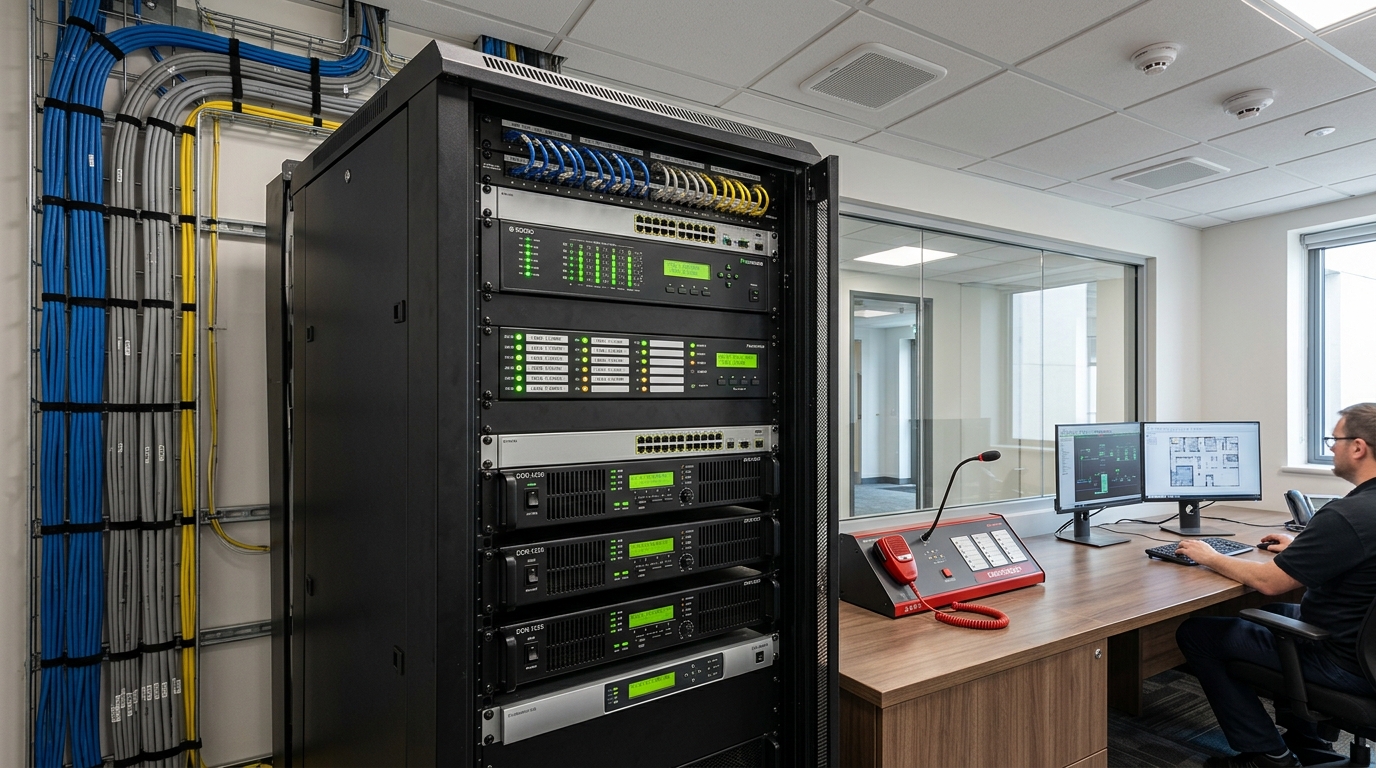
Integrated PA & Emergency Voice Alarm Architecture
HORNET INFOTECH provides turnkey audio and emergency communications engineering. We implement zoned paging systems, background music distribution, high-efficiency Class-D amplification, acoustic modeling, and fully supervised voice evacuation systems integrated with building fire protection where specified.
Zone-based paging routing, desktop and master microphone stations, high-fidelity background music ingestion, and multi-tier priority paging management configured to facility operational workflows.
Automated emergency voice messages, priority override triggering, phased zone evacuation messaging, and supervised hardwired interlocks with fire alarm control panels where required.
Centralized and networked amplification racks, zone distribution switching, ceiling, wall column, and industrial horn loudspeakers selected for environmental conditions, and supervised circuits where applicable.
Fire alarm system interface, BMS control and monitoring interfaces where required, comprehensive acoustic testing, Speech Transmission Index (STI) verification, handover documentation, and scheduled AMC support.
7-Stage Public Address & Voice Alarm Ecosystem
Every stage from audio ingestion to acoustic transducers and emergency life-safety interfaces operates under monitored supervision to ensure uninterrupted speech clarity and compliance.
Audio Sources
Desktop paging microphones, digital media players, SIP audio gateways, and scheduled chime tone generators.
Control & Routing
Acoustic digital signal processors, matrix routers, zone controllers, and priority routing logic modules.
Voice Alarm Core
Voice alarm master controllers, supervised message storage, and monitored emergency microphone consoles where specified.
Amplification
Energy-efficient Class-D multichannel power amplifiers with automatic standby amplifier switchover and 24V DC battery backup.
Zoned Audio Distribution
Supervised audio distribution lines, 100V/70V constant-voltage lines or low-impedance zones, fire-rated cabling where specified, and line impedance monitoring.
Loudspeakers
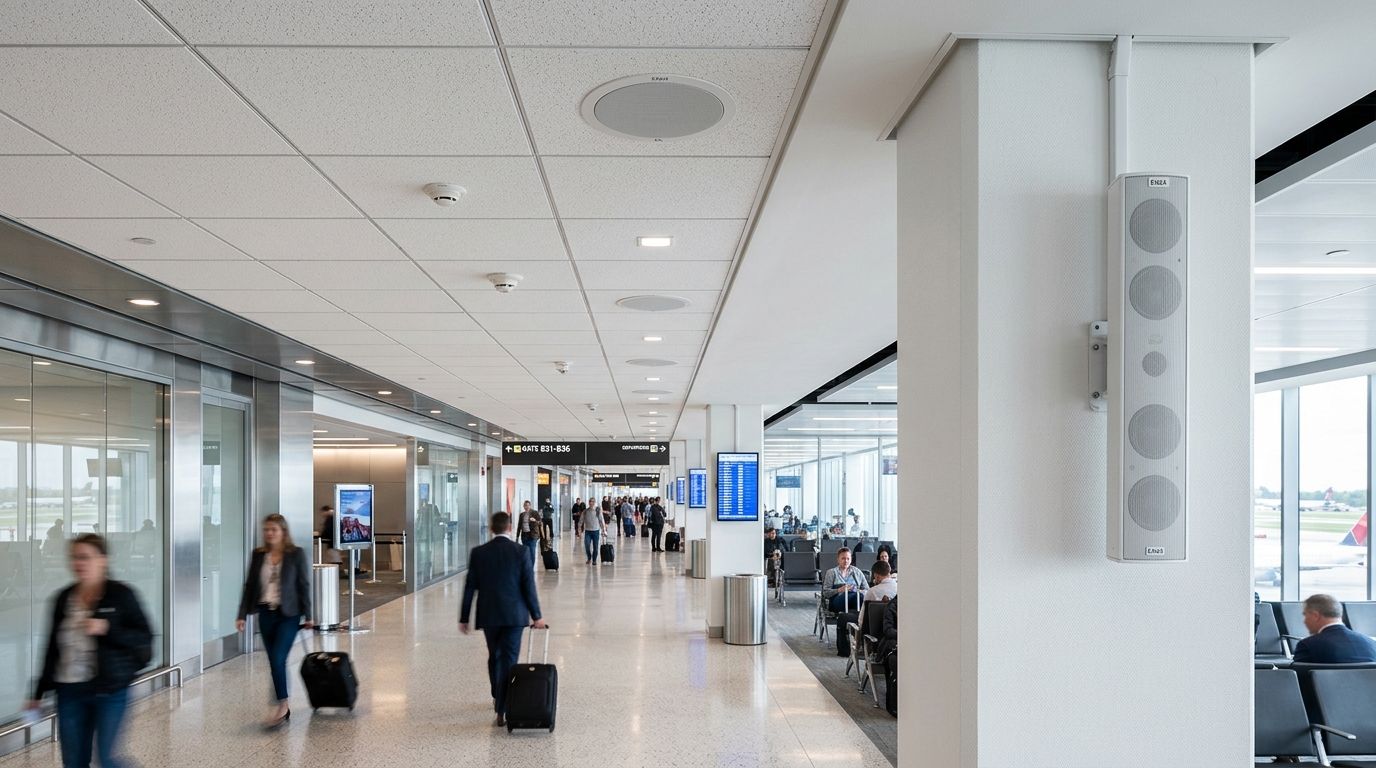
Ceiling flush-mount speakers, architectural sound columns, and high-decibel industrial projector horns matched to room acoustics.
Monitoring & Safety
Direct fire alarm control panel interfaces, line fault telemetry, continuous system self-diagnostics, and preventive maintenance.
Deployment Environments & Operational Profiles
Public address and voice alarm systems require customized acoustic engineering based on ambient noise levels, reverberation characteristics, zoning complexity, and statutory evacuation protocols.
Corporate & Commercial
Multi-tenant commercial towers, corporate atriums, and executive office floors requiring acoustic speech intelligibility, discreet ceiling speakers, zoned announcements, and scheduled chimes.
Healthcare
Hospitals, specialty healthcare institutes, and clinical wings requiring low-stress acoustic zoning, nurse-call paging coordination, and voice evacuation protocols designed to EN 54 requirements where specified.
Education & Institutional
University campuses, auditoriums, lecture halls, and administrative wings with multi-zone bell schedules, sports complex public address, and campus-wide emergency lockdown alerts.
Hotels & Hospitality
Luxury hotels, resorts, banquet halls, and public corridors combining continuous high-fidelity background music (BGM) with prioritized voice evacuation messaging as designed.
Industrial & Manufacturing
High-noise manufacturing floors, logistics hubs, and hazardous processing plants requiring high-output weatherproof re-entrant horn speakers and ambient noise-compensating amplifiers.
Transport / Public Facilities
Railway stations, passenger concourses, airport terminals, and multimodal transit hubs requiring STI-verified intelligibility, automated pre-recorded travel updates, and phased evacuation zoning.
Detailed Technical Specifications & Design Review
Acoustic zone schedules, speaker coverage layouts, amplifier load calculations, voice alarm controller architecture, supervised speaker cable schedules, and fire alarm cause-and-effect interfaces are formulated by our engineering team based on project specifications.
Documented Project Deployments
Verified corporate infrastructure delivered, commissioned, and handed over by HORNET INFOTECH.
eClerx Corporate Facility ELV & ICT Infrastructure (Phase 1)
Integrated ELV, electronic security, life safety, and network cabling infrastructure deployed for eClerx Chandigarh (Phase 1), supporting 216 CCTV surveillance cameras, a 340-device addressable fire alarm system, 170 PA speakers/units, 30 access-controlled doors, 1,500+ structured cabling data points, Novec clean-agent suppression, VESDA, WLD, and rodent detection.
eClerx Corporate Facility ELV & ICT Infrastructure (Phase 2)
Integrated ELV, electronic security, life safety, and network cabling infrastructure deployed for eClerx Chandigarh (Phase 2), supporting 178 CCTV surveillance cameras, a 215-device addressable fire alarm system, 120 PA speakers/units, 23 access-controlled doors, 1,000+ structured cabling data points, Novec clean-agent suppression, VESDA, WLD, and rodent detection.
Related Communications & Life Safety Solutions
Addressable fire alarm control panels, smoke sensor loops, and critical cause-and-effect interlocks triggering prioritized emergency voice evacuation messages.
Centralized display walls and audio-visual monitoring matrices providing SOC/NOC operators situational awareness during emergency alerts and facility announcements.
Boardroom digital audio DSP, beamforming microphone arrays, and unified meeting room acoustics complementing facility-wide paging infrastructure.
Dante, AES67, and IP-audio network switching, QoS prioritization, and structured backbones interconnecting decentralized audio amplifier nodes.